my shops are finally open !
selected-countries only shop + worldwide shipping store
my shops are finally open !
selected-countries only shop + worldwide shipping store

If you’re uncomfortable or impatient reading this, you can try watching the video essay versions on my social media or in Youtube.
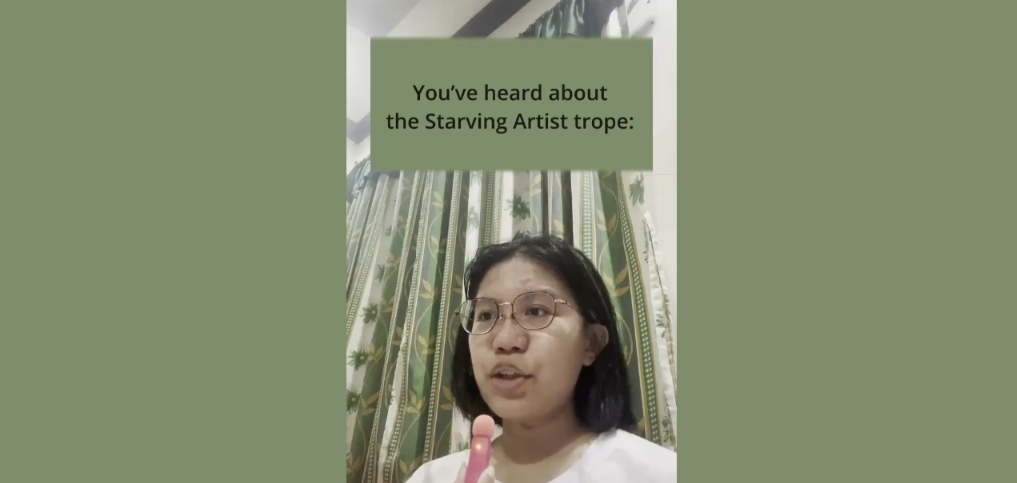
You’ve heard about the Starving Artist trope: how poverty is necessary to become One of the Greats ™
Bach, Mozart, Van Gogh, Michelangelo. These are the Greats ™ and if we have heard from them, it’s because we knew them. We knew of their art, their name, and their works.
But look closer and you’ll notice something.
Many of them had someone who saw them first and had to rely on patrons. Vincent Van Gogh was supported by his own brother, Theo.
We remember the artists who got seen. The ones who weren’t? We’ll never know their names.
This Starving Artist trope glorifies the title of being an artist, at the cost of suffering for years. Within this trope, it perpetuates the mindset that artists do it for the love of it, for the sake of making art. As if love pays rent, utilities, or medicine. Artists in all generations and of different ages are workers. Artists are labourers.
Hello hi welcome, I’m Alissa.
The job market is so cooked I have no choice but to follow my dreams. Here I am, a comic author-artist and a writer/video essayist/blogger, I suppose. I wanted to be a published musician-songwriter but baby steps first.
Today, I’m briefly discussing ALISCELLANY’s first article/blog/video essay titled: “An Artist Whose Work Is Not Seen Will Starve”.
And it begins with a memory:
When I was in university, my mother and I sat across from the dean of the Engineering and Architecture Department of my previous school. Or was it the director, or some honorable title? I forgot. I really couldn’t feel her presence, I didn’t even know she was one. I did hear the slow clacking of her heels in the hallways. But I digress. She looked at me and said: “From Architecture to Education? Ang layo. (It’s so far).”
Just recently, a younger friend of mine shared how her parents did not want her to be in a humanities degree especially in a degree like hers. I asked her, what kind of jobs are in there anyway? Somehow, I felt a bit guilty in asking. It was my own past, handed back to me.
In the Philippines, art is seen as an impracticality, or worse, a hobby.
Walang pera sa art, there’s no money in art, so parents would often encourage or force their children toward “practical”, elite-sounding pursuits such as Medicine or Engineering.
It is not only parents.
A recent news report described how Filipino culture has long looked down on any degree that is not engineering, business, or nursing. That “walang pera diyan” mindset shapes how we value creative work: as something cheap, trivial, easy, or made without effort. Think of the “pasulat nga” (can you write for me?), the “pagawa naman ng poster” (can you make me a poster?), as if it were an errand.
I then remembered the top 2 student in our batch during my junior highschool days (Grades 9 to 10) who had her entire graduation speech made by me, by the way.
Or how this girl who was also a transferee as I am in Grade 8 would force me to make an essay even up to our college days (she from another program, me when I was still in Architecture).
“Fudge, pagawa nga essay?” (Fudge, can you make me an essay?)
She chatted me for the 2nd time while I was going home, sleepy on the jeepney, at 11:59 PM. And when I told her no, her tone changed from being sweet to demanding. “Sige na fudge, please.”
I digress. Again.
Of course there’s money in Engineering. Just look at the news about Flood Control projects and how all or most officials in the Philippine government would pocket the tax money of the people. Of course there would be money there. But follow that money closely…
Funds meant for the people, for the schools, for public programs, for the arts, disappeared into pockets and into the golfing sessions and luxurious clothes of their own children. Loving your children will never be a crime. Paying for their luxuries with the people’s money is. That luxury came from unethical means; of course the people should not forget.
When we say there is no money in art, we are not describing a natural law. We are describing a systemic failure. Theft of government officials, their assistants, their cronies who were supposed to manage public funds for the people.
Part of this is colonial.
Filipinos are often romanticized as a hospitable race, a friendly face.
We were taught to love what looks prestigious, what sounds foreign, what sounds like it came from above.
We were raised on the bahala na (let it be, come what may) and on the idea that suffering now earns rewards later. “In another life”, as what the kids say.
Why couldn’t we do it in this life? Why do the older generation always project their dreams into ours while questioning our choices and our decisions?
You would think that the creative industry itself would be a safe place. It isn’t.
In January 2026, the same news report described several Filipino creatives publicly accusing one of the country’s top fashion magazines of paying late, or not at all. One photographer said a project from March 2024 was still unpaid at the end of 2025. After he posted about it, the magazine reportedly sent proof of payment the next day.
This isn’t just a local problem.
In September 2026, an independent artist in the UK posted on her account about working a last-minute event for a global luxury fashion house. According to her, she received the materials and instructions the day before. She worked an 11-hour shift on a stool, six months pregnant, and spent the next three months chasing a £1,600 invoice. She said many of her emails were ignored and that her supplier account was only approved minutes after she wrote that she would take legal action and go public. Her post spread.
Two days later, she announced in a follow-up post that she had been paid.
It wasn’t only her.
That same month, another creative posted an update stating she had finally been paid by a former employer. She said she had been scared to speak up and that it had been weighing on her for years. One carousel post, she said, resolved her situation in 2 days, “something almost 2 years of follow-up emails could not.” She also said she was disappointed that she had to resort to a public callout, but thankfully, she was able to get a former contractor paid, too.
Read these stories again. Different people, different creative industries. The same ending. The money was never missing. The attention was. None of these creatives got paid until the whole internet was watching.
And look closely what held them back. One said they worried about being “annoying” and about not getting hired again. Another said they were scared to speak up. The Filipino creatives in the report mostly spoke anonymously, and you can already know why that is.
Generally, artists stay quiet because being seen as the “complainer” can cost them future work. Then the system calls the delay: “It’s just how things are,” and then the cycle continues.
I did not receive this idea from the Heavens.
The idea for this article was because I keep seeing on social media about artists stating that “we don’t want to make reels or video form just to satisfy the algorithm. We are illustrators, not video creators.” And I do agree with them. Many artists feel they are no longer creating art but feeding a machine.
I do want to say something that might be unpopular and might raise eyebrows: maybe we can embrace this content creation as part of the creative process, too. Not because anyone should be forced, but because a shift in our mindset might help ease this.
Art is self-expression. Content is communication.
Making a reel is also a skill, and who knows, you also might discover another skill or art you might enjoy.
Artists have always had to promote themselves. Before, it was courting galleries or having a patron of wealthy or religious standing.
Now it means getting behind a camera.
Here’s where it gets bad, though. Encouraging a mindset is one thing, but being cornered is another.
In the comments on this post, one artist puts it better than I ever could: artists have always had to market themselves, but modern content creation is a separate, commercial skill set, and algorithms punish those who skip it. Most artists have a problem because “they’re not getting a choice.”
I feel the same way about comics.
As a comic author-artist, I thought I’d be free from the algorithm on comic platforms. I was in those spaces with the mindset of “Finally, I can share and promote my work!” only to discover that my own comic platform has an algorithm, too.
These platforms already have an Originals tab for original works made by original artists. And yet, they still promote these works inside a tab that should feature Not-Originals.
What’s funny is that some of these Originals are not really suited to be called Originals because it’s the same plot all over again just with different art styles.
To say that it’s unfair is an understatement. It’s disgusting.
Platforms should be fair to everyone whether they are a new artist or a veteran. So when we look closely at who runs them, we have to ask: are the owners even artists themselves? Do they know what it is like to work for years and still go unseen?
If the work is not seen, the artist starves. If the artist is gatekept, the artist starves. So visibility is not a luxury, it is part of a living wage.
To platforms: give the non-Originals a fair chance at discovery and be transparent about promotion, pricing, and contracts.
Don’t make artists become full-time social media managers just to be found.
To payers: pay on time, pay in full, so no artist needs a viral post to get what they are owed.
To fellow artists: speak up when you can, and consider that learning to communicate your art may be one more skill, but not a betrayal of it.
To readers and supporters: follow the artists you love, share their work, and pay for it when you can.
Because an artist whose work is not seen will starve. So let’s make sure that we’re looking.
Serenade Magazine: https://serenademagazine.art/the-starving-artist-myth-romanticism-vs-reality/
Inquirer Lifestyle: https://lifestyle.inquirer.net/560418/its-a-tough-time-to-be-a-creative/
Modesto III Banzon (Post): https://www.instagram.com/p/DS26qe5iqiK
Raymakesthings (Post 1): https://www.instagram.com/p/Dc8DpbqgLOC
Raymakesthings (Post 2): https://www.instagram.com/p/Dc_sSTxgXvK
Edgykatrina (Post): https://www.instagram.com/p/Dc30gNJFGG5
Leendoodles: https://www.instagram.com/p/DdWd7MaiYIY